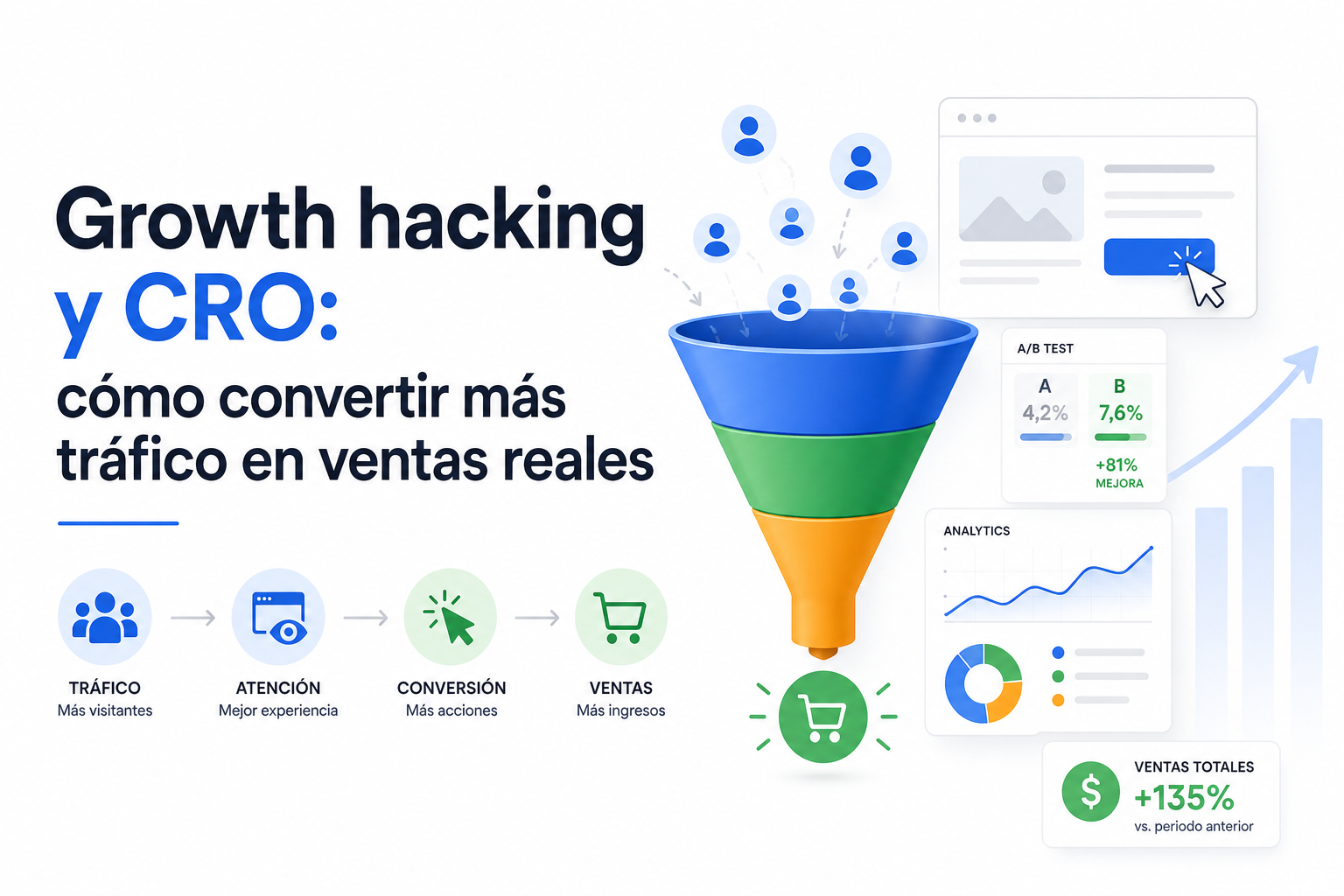
Growing a Shopify store is not just about getting more traffic. In fact, many brands are increasingly investing in campaigns, content, social media, or acquisition, but still encounter the same problem: growth doesn't scale at the same pace as effort.
Growth hacking for Shopify was born precisely to solve this blockage. It's not about applying quick tricks, copying viral tactics, or trying aimless actions. It's about creating a data-driven experimentation and optimization system, capable of scaling qualified traffic, improving conversion, and increasing customer retention.
In this guide, we will see how to apply a Shopify growth hacking strategy step by step, which metrics to analyze, what experiments you can launch, and how to connect SEO, CRO, analytics, automation, and retention to grow more sustainably.
What is growth hacking applied to Shopify?
Growth hacking applied to Shopify is a growth methodology that combines marketing, analytics, technology, creativity, and experimentation to identify improvement opportunities in an online store.
Its goal is not simply to sell more in the short term, but to find which levers can generate real growth at each stage of the funnel: acquisition, activation, conversion, retention, and referral.
If you want to delve deeper into the concept, at Webmefy we have also explained what growth hacking applied to eCommerce is and why it has become a key methodology for brands that want to grow with data and not just intuition.
Growth hacking is not about tricks, it's about experimenting with data
One of the most common mistakes is to think that growth hacking consists of finding a magical "hack" that skyrockets sales overnight. But sustainable growth rarely works that way.
In a Shopify store, a good strategy begins by analyzing real data: where traffic comes from, which pages convert best, where users abandon, which products generate more recurrence, which campaigns have the best return, and which segments buy most frequently.
From there, measurable hypotheses are proposed. For example:
- If we improve the product page with clearer benefits, the conversion rate will increase.
- If we create SEO content aimed at search intent, we will capture qualified traffic that we are not currently working on.
- If we activate personalized post-purchase flows, the repurchase rate will increase.
- If we simplify mobile navigation, the number of users reaching the product will grow.
That is the essence of growth hacking: observe, prioritize, experiment, measure, and scale what works.
Differences between growth hacking, digital marketing, and CRO
Although closely related, growth hacking, digital marketing, and CRO are not exactly the same.
- Digital marketing: focuses on activating channels such as SEO, paid media, email marketing, social media, or content to attract users.
- CRO: focuses on improving the conversion rate, reducing friction on the website, product pages, cart, or checkout.
- Growth hacking: integrates acquisition, conversion, retention, analytics, and experimentation to detect growth opportunities throughout the system.
Therefore, growth hacking does not replace marketing or CRO. It connects them under the same logic: grow more and better, making data-driven decisions.
It is also important to differentiate it from growth marketing. If you want to better understand the nuances between both approaches, you can read our comparison of growth hacking vs growth marketing.
When does it make sense to apply it in a Shopify store?
Growth hacking makes sense when a Shopify store already has a minimum base on which to experiment: some traffic, behavioral data, previous sales, or a validated value proposition.
It is especially useful when:
- The store receives visits, but converts below expectations.
- The cost of acquisition increases and profitability decreases.
- The brand relies too much on paid campaigns.
- There is organic traffic, but it does not convert into sales.
- Customers buy once, but do not return.
- The team launches actions, but does not know which ones generate real impact.
- The eCommerce needs to scale without losing margin.
Why Shopify needs a growth strategy beyond traffic
In eCommerce, it's very tempting to think that the problem is always a lack of visitors. But attracting more traffic is not very useful if the store is not prepared to convert, if the user does not find what they are looking for, or if customers do not repeat purchases.
A Shopify store can have a lot of traffic and still not grow profitably. Therefore, growth hacking looks at the business comprehensively: acquisition, conversion, average order value, recurrence, margin, and customer lifetime value.
The mistake of relying solely on paid campaigns
Paid campaigns can accelerate growth, but relying solely on paid media is risky. Costs rise, algorithms change, competition increases, and margins can quickly erode.
The problem is not investing in paid media, but doing so on a store that is not optimized. If the product page is not convincing, if the checkout generates doubts, or if there are no automations to recover users, every paid click loses efficiency.
Growth hacking seeks to balance this dependence by creating its own assets: organic traffic, evergreen content, databases, automations, retention strategies, CRO, and user experience.
How to connect acquisition, conversion, and retention
Real growth occurs when levers feed each other. SEO attracts qualified users. UX facilitates navigation. Copy helps understand product value. CRO improves conversion. Analytics allows prioritization. Automations recover customers and encourage repurchase.
If each area works separately, growth is fragmented. If they all work under the same strategy, each improvement multiplies the impact of the next.
This approach fits very well with the AARRR funnel applied to eCommerce, because it allows analyzing at which stage growth is being lost: acquisition, activation, retention, referral, or revenue.
What metrics you should look at before launching experiments
Before launching experiments, you need to know where the bottleneck is. To do this, it is advisable to review metrics such as:
- Qualified traffic: organic, paid, social, email, referral, and direct traffic.
- Conversion rate: percentage of users who end up buying.
- Add to cart: users who add products to the cart.
- Checkout initiation: users who proceed to purchase.
- Cart abandonment: users who do not complete the order.
- Average order value: average value of each purchase.
- LTV: value a customer generates during their relationship with the brand.
- Repurchase rate: percentage of customers who buy again.
- Purchase frequency: average time between one purchase and another.
Without this prior analysis, any action can become a gamble. With data, every experiment has a reason to be.
The 3 levers of growth hacking for Shopify
To apply growth hacking in Shopify in an orderly manner, it is advisable to work on three major levers: traffic, conversion, and recurrence.
These three areas determine whether an online store can grow profitably or if it is simply generating activity without real impact.
Traffic: attracting qualified users from SEO, paid media, and content
Traffic is not worth the same if it does not respond to a clear intention. The goal is not to attract visits by volume, but to capture users who are close to discovering, comparing, or buying products like yours.
In Shopify, qualified traffic can be worked on through different channels:
- SEO for collections and products.
- Evergreen content on the blog.
- Buying guides.
- Comparisons.
- Segmented paid media.
- Remarketing.
- Email marketing.
- Social media content.
In our guide on growth hacking strategies for eCommerce, we explain how to combine different actions to acquire, convert, and retain users without relying on a single traffic source.
Conversion: reducing friction in product pages, cart, and checkout
Conversion is one of the most profitable levers because it leverages the traffic you already have. If a store receives visits, improving the percentage of users who buy can have a direct impact on revenue without necessarily increasing investment in acquisition.
In Shopify, conversion opportunities often appear at very specific points:
- Product pages with little useful information.
- Insufficient or unclear images.
- Lack of trust or social proof.
- Shipping costs visible too late.
- Ineffective filters.
- Confusing menus.
- Improvable mobile speed.
- Absent FAQs for complex products.
The key is to detect what friction is hindering the purchase and turn it into a hypothesis for improvement.
Recurrence: getting the customer to buy again
Recurrence is one of the big differences between a store that sells and a store that scales. Acquiring a new customer is usually more expensive than getting a satisfied customer to buy again.
In Shopify, recurrence can be worked on with email flows, SMS, post-purchase campaigns, personalized recommendations, bundles, cross-selling, loyalty programs, and behavioral segmentation.
Here, growth hacking does not aim to send more impacts, but to send better messages at the right time: welcome, cart recovery, post-purchase, replenishment, complementary product recommendations, reactivation, and loyalty.
How to scale qualified traffic in Shopify
Scaling qualified traffic in Shopify requires a strategy that connects architecture, content, search intent, and conversion. It's not about publishing for the sake of publishing, but about creating assets that can attract demand sustainably.
SEO for Shopify: architecture, collections, and evergreen content
A well-optimized Shopify store should have clear collections, clean URLs, well-crafted SEO titles, persuasive meta descriptions, consistent H1s, useful texts, and strategic internal linking.
If the goal is to scale organic traffic profitably, having an SEO agency specialized in eCommerce can help you prioritize which pages to work on first, which keywords to target, and how to connect informational content with transactional pages.
Collections usually respond to a transactional intent. The blog, on the other hand, can capture informational searches with commercial potential. For example:
- How to choose a product.
- What product to use based on a need.
- Comparisons between options.
- Usage ideas.
- Maintenance tips.
- Seasonal trends.
- Frequently asked questions before buying.
This type of content helps position new keywords, improves thematic authority, and allows linking to relevant categories or products without forcing a sale.
Content oriented to search intent and AI results
To appear in AI results, it is not enough to repeat keywords. The content must be clear, useful, structured, and easy to interpret.
Good content for Shopify should include simple definitions, concrete steps, examples, FAQs, comparisons, recommendations, and internal links that help the user advance.
The easier it is for Google, Bing, or an AI system to understand the answer, the more likely the content is to appear as a reference. Therefore, current SEO must work not only on the keyword, but also on the intent, context, and real utility of the content.
Internal linking to reinforce the growth hacking cluster
Internal linking is key to building thematic authority. If a brand wants to position itself as a reference in growth hacking, it cannot depend on a single article.
It needs a cluster capable of answering different searches: what is growth hacking, how it is applied in eCommerce, what an agency does, how the AARRR funnel works, what are the differences with growth marketing, and how to implement it in Shopify.
This structure allows each piece of content to reinforce the others and for Google to better understand the brand's specialization in this topic. Therefore, in addition to this article, it is important to connect with content such as what a growth hacking agency does and with the service page for a growth hacking agency.
Paid media and remarketing without relying solely on discounts
Paid media can be very useful for accelerating traffic, validating messages, and capturing demand. But it should not rely solely on discounts.
A more sustainable strategy combines segmented campaigns, remarketing, proprietary audiences, creatives aligned with the user's moment, and messages focused on value, not just price.
The goal is for advertising not to function as an isolated solution, but as another lever within a growth system.
How to improve conversion in a Shopify store
Once traffic reaches the store, the question changes: is the experience ready to convert? In many e-commerce businesses, the problem is not in acquisition, but in the friction the user encounters before buying.
Product page optimization: images, copy, trust, and FAQs
The product page is one of the most important pages in a Shopify store. It must answer questions, build trust, and facilitate the purchase decision.
To improve its performance, it is advisable to work on elements such as:
- Clear, real images adapted for mobile.
- Visible benefits at first glance.
- Descriptions aimed at answering questions, not just listing features.
- Size guides, measurements, materials, or instructions when applicable.
- Product-specific FAQs.
- Shipping, exchange, and return information.
- Reviews or trust signals.
- Related or complementary products.
Each improvement should be formulated as a measurable hypothesis. For example: "if we add a FAQ about sizing, we will reduce doubts and increase add to cart."
Menus, filters, and navigation to reduce friction
In Shopify, navigation can boost or hinder conversion. A poorly organized menu makes it take longer for the user to find what they are looking for. Unclear filters can block exploration. A confusing architecture can dilute both SEO and the shopping experience.
A growth hacking strategy reviews how users navigate, what categories they visit, where they abandon, and what elements generate more interaction. From there, improvements can be prioritized for menus, filters, internal search engines, breadcrumbs, or recommendation blocks.
Speed, mobile-first, and shopping experience
Most users discover and buy from mobile. Therefore, a slow Shopify store, with heavy images, inaccessible buttons, or difficult-to-read texts is missing opportunities.
Optimizing speed, accessibility, and mobile experience is not just a technical issue. It also impacts SEO, conversion, and profitability.
A/B tests and CRO experiments with clear hypotheses
A/B testing allows validating whether a change actually improves conversion. It can be applied to headlines, calls to action, trust blocks, content order, product pages, banners, forms, or cart messages.
But the test only makes sense if it starts from a clear hypothesis. Changing for the sake of changing is not growth hacking. Testing, measuring, learning, and scaling is.
How to increase recurrence and the value of each customer
Scaling a Shopify store does not solely depend on selling more to new users. It also depends on building a more profitable relationship with customers who have already purchased.
Segmentation by purchase behavior
Not all customers are the same. Some buy once and disappear. Others repeat. Others buy multiple categories. Others only react to promotions.
Growth hacking uses this information to segment and personalize. In Shopify, you can work with segments based on:
- Product purchased.
- Category of interest.
- Purchase frequency.
- Average order value.
- Recurring customers.
- Inactive customers.
- Users who abandon carts.
- Users who visit a product without buying.
Email and SMS flows for repurchase, cross-sell, and recovery
Automations allow working on recurrence in a scalable way. It's not about sending newsletters without strategy, but about designing flows that accompany the user according to their behavior.
Some key flows for Shopify are:
- Welcome to new subscribers.
- Abandoned cart.
- Browse abandonment.
- Post-purchase.
- Cross-sell.
- Product replenishment.
- Inactive customer reactivation.
- Customer loyalty for repeat customers.
Loyalty programs and benefits for repeat customers
Loyalty isn't just about offering points or discounts. It can also be built through early access, exclusive benefits, personalized content, private launches, gifts, experiences, or relevant recommendations.
The important thing is for the customer to have real reasons to return beyond just the price.
How to measure LTV, purchase frequency, and repeat purchase rate
If we only measure immediate sales, we miss a significant part of growth. A Shopify store needs to understand how much each customer is truly worth over time.
- LTV: the value a customer generates during their relationship with the brand.
- Repeat purchase rate: the percentage of customers who buy more than once.
- Purchase frequency: the average time between one purchase and the next.
- Margin per customer: actual profitability beyond revenue.
Sometimes, the most profitable experiment isn't acquiring more users, but getting current customers to make a second purchase.
Step-by-step growth hacking framework for Shopify
For growth hacking to work, it needs a method. Just having ideas isn't enough. You have to prioritize them, measure them, and learn from each experiment.
Step 1: Identify the main bottleneck
Before launching actions, you need to identify where the problem lies. It could be in acquisition, conversion, average order value, recurrence, or measurement.
If the store has a lot of traffic but few sales, perhaps the focus should be on CRO. If it converts well but barely receives visits, the focus will be on SEO, content, or paid media. If it sells once but customers don't return, you'll need to work on retention and automation.
Step 2: Prioritize experiments by impact, effort, and confidence
Not all experiments have the same value. Some require development, design, or time. Others can be implemented quickly and generate immediate learning.
A good way to prioritize is to evaluate each idea based on:
- Potential impact.
- Required effort.
- Confidence in the hypothesis.
- Implementation speed.
Step 3: Define hypothesis, main metric, and test duration
Each experiment should have a clear hypothesis. For example:
- If we add product comparisons to collections, clicks to product pages will increase.
- If we improve the SEO content of the main collections, non-branded organic traffic will increase.
- If we activate a post-purchase flow with complementary recommendations, the repurchase rate will increase.
Then you need to define which metric will validate or discard the hypothesis: conversion, clicks, add to cart, revenue, repurchase rate, average ticket, or leads.
Step 4: Measure results and scale what works
The key to growth hacking is not just about testing, but about learning. An experiment may not yield the expected result and still be useful if it helps to better understand the user.
When a hypothesis works, it's scaled. When it doesn't work, it's documented and reformulated. Over time, this process creates a proprietary growth system for the store.
Step 5: Document learnings to create a growth system
Every experiment should provide a clear learning: what was tested, why it was done, what happened, which metric moved, and what decision was made afterward.
Thus, growth hacking ceases to depend on isolated ideas and becomes an internal methodology for continuous improvement.
Examples of growth hacking experiments for Shopify
To put the methodology into practice, here are some examples of experiments that could be applied in a Shopify store.
Experiments to increase organic traffic
- Create SEO clusters around priority categories.
- Optimize titles, metas, and H1s of collections with purchase intent.
- Add useful SEO text below the product grid.
- Publish buying guides connected to collections.
- Improve internal linking between blog, collections, and products.
- Implement structured data according to page type.
Experiments to improve product conversion
- Add FAQs to product pages.
- Improve the above-the-fold block on mobile.
- Reorder shipping and return information.
- Highlight differentiating benefits near the buy button.
- Optimize images for speed and clarity.
- Test related product blocks.
Experiments to reduce cart abandonment
- Display shipping information before checkout.
- Review surprise costs or frictions in the purchase process.
- Activate segmented abandoned cart emails.
- Test real urgency messages, not artificial ones.
- Offer complementary recommendations without oversaturating.
Experiments to increase repurchases
- Create post-purchase flows by category.
- Send recommendations based on purchased product.
- Design campaigns for inactive customers.
- Create recurring bundles or packs.
- Work on content for use, care, or inspiration after purchase.
Experiments to improve average order value
- Test packs or bundles with complementary products.
- Display recommendations before checkout.
- Create profitable free shipping thresholds.
- Highlight higher-margin products.
- Offer upgrades or premium versions when appropriate.
Common mistakes when applying growth hacking in Shopify
Growth hacking can be very powerful, but only if applied judiciously. Here are some common mistakes to avoid.
Launching actions without sufficient data
Testing just for the sake of testing is not growth hacking. Before making changes, you need to analyze data, detect patterns, and prioritize based on impact.
Copying tactics from other brands without context
What works for one store may not work for another. Each eCommerce has its product, margin, audience, buying cycle, value proposition, and level of maturity.
Measuring only sales and not micro-conversions
Sales are important, but they don't always explain everything. You also need to measure clicks, scroll, add to cart, checkout initiation, filter interaction, abandonment, and recurrence.
Not connecting SEO, CRO, analytics, and automation
Growth becomes more powerful when areas are connected. SEO attracts, CRO converts, analytics prioritizes, and automation retains. Separating them limits the impact.
Running tests without enough traffic or a clear hypothesis
Not all tests make sense at all times. If there isn't enough traffic, it may be better to analyze qualitative data, review behavior, improve architecture, or prioritize changes with a high probability of impact before launching a statistical test.
What a Shopify store needs to scale sustainably
A Shopify store ready for growth needs much more than a pretty template or active campaigns. It needs a strategic and technical foundation that allows it to scale without breaking profitability.
A solid technical foundation
The store must load fast, work well on mobile, have a crawlable structure, avoid unnecessary duplication, and make it easy for Google to understand its main pages.
An SEO architecture designed for growth
Categories, collections, products, and content must be organized logically. This helps both the user and search engines.
Working on this architecture with a specialized SEO strategy allows prioritizing URLs with the highest potential, avoiding cannibalization, and creating a structure ready to scale on Google, Bing, and AI results.
A conversion-oriented user experience
The user must be able to find, understand, and buy without friction. Every extra step can become a lost opportunity.
A retention and automation strategy
The sale doesn't end at checkout. Post-purchase, loyalty, and repurchases are key to increasing profitability.
A clear measurement system in GA4 and Shopify
Without measurement, there is no growth hacking. It is essential to have a clear analytical configuration that allows you to know what is working, what is not, and where opportunities are being lost.
How Webmefy can help you apply growth hacking in Shopify
Applying growth hacking in Shopify requires strategic vision, technical capability, and constant analysis. It's not just about proposing ideas, but about prioritizing, executing, measuring, and scaling what works.
A growth hacking agency can help you identify the main bottlenecks of your eCommerce and convert them into an actionable experimentation plan.
At Webmefy, we approach growth with an integral vision: SEO, CRO, UX/UI, analytics, automation, and Shopify development. The goal is not to do more actions, but to do the actions that make the most sense to improve traffic, conversion, recurrence, and profitability.
Technical SEO and content to capture qualified demand
From architecture to intent-oriented evergreen content, we help your store be visible to users looking for a real solution, not just any product.
This part connects directly with our work as an SEO agency, where we prioritize qualified traffic, architecture, content, and organic growth opportunities, through a Shopify SEO audit.
CRO and UX/UI to better convert existing traffic
We analyze frictions in product pages, menus, navigation, mobile experience, cart, and checkout to improve the performance of existing store traffic.
Analytics, dashboards, and experiment measurement
We define metrics, configure measurement, and create dashboards that allow data-driven decisions, not assumptions.
Automations to increase recurrence and profitability
We design flows and automation strategies aimed at recovering users, fostering repurchases, and increasing the value of each customer.
Shopify development oriented to growth
We improve performance, tool integration, and user experience on Shopify with a mindset of scalability, measurement, and continuous improvement.
Frequently asked questions about growth hacking for Shopify
What is growth hacking for Shopify?
Growth hacking for Shopify is a data-driven and experimentation-based growth methodology that seeks to improve the main levers of an online store: traffic, conversion, recurrence, average order value, and profitability.
What is the difference between growth hacking and CRO?
CRO focuses on improving conversion, while growth hacking works across the entire growth system. It includes CRO, but also SEO, acquisition, retention, automation, analytics, and experiments aimed at scaling the business.
When should I apply growth hacking to my Shopify store?
It makes sense to apply it when a store already has a certain volume of data or when it needs to grow more efficiently. It is also useful if there is traffic but few sales, if campaigns are increasingly expensive, or if customers are not making repeat purchases.
What metrics are most important for scaling an eCommerce?
It depends on the bottleneck, but some key metrics are qualified traffic, conversion rate, add to cart, cart abandonment, average order value, revenue, margin, LTV, repurchase rate, purchase frequency, and profitability per channel.
Can growth hacking be done without investing in paid media?
Yes. Although advertising can accelerate learning, experiments can also be planned using SEO, content, email marketing, UX, CRO, automation, loyalty, and product improvement. The important thing is to prioritize measurable actions connected to business objectives.
How do I know which experiment to prioritize first?
First, you need to identify the main bottleneck. Then, each experiment can be evaluated based on potential impact, effort, confidence in the hypothesis, and speed of implementation.
How long does it take to see the impact of a growth hacking strategy?
It depends on the type of experiment. Some conversion improvements can show signs in a few weeks if there is enough traffic. SEO actions usually need more time, but they can also generate a more sustainable impact in the medium and long term.
What tools are needed for growth hacking in Shopify?
The most important thing is not to accumulate tools, but to have good measurement. Shopify, GA4, Google Search Console, heatmap tools, email marketing platforms, dashboards, and testing solutions can help detect opportunities and validate experiments.