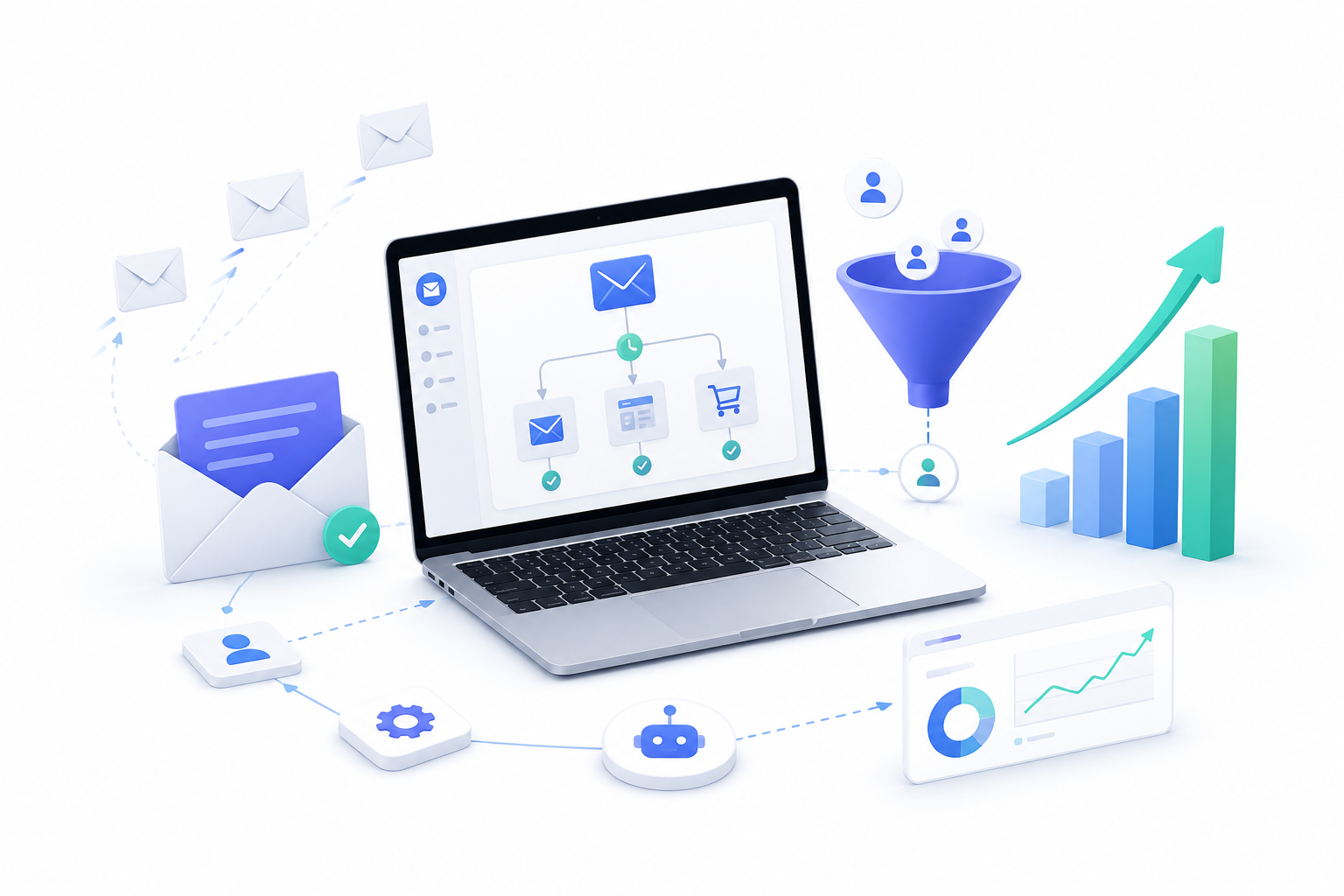
Growth hacking helps to identify growth opportunities through experimentation, creativity, data, and high-impact actions. CRO, or Conversion Rate Optimization, focuses on improving the percentage of users who complete a key action: buying, registering, requesting information, adding a product to the cart, or advancing through the funnel.
When both strategies are combined well, the goal is no longer just to "get more visits" and becomes much more profitable: better converting the traffic you already have, reducing friction, and scaling what works.
What is the relationship between growth hacking and CRO?
Growth hacking and CRO share the same foundation: analyzing data, identifying opportunities, launching experiments, and continuously improving the performance of a digital business.
Although they have different approaches, their ultimate goal is very similar: to help an eCommerce grow, sell more, and better utilize its resources without relying solely on increasing investment in traffic or advertising.
Attracting traffic to an eCommerce is important, but not enough. You can invest in SEO, paid media, email marketing, social media, or acquisition campaigns, and still not achieve the expected results if your online store doesn't convert well.
This is where two disciplines that should work together come into play: growth hacking and CRO.
Growth hacking: accelerating growth through experimentation
Growth hacking is a methodology aimed at finding fast, measurable, and scalable growth levers. It originated closely linked to the startup environment, but today it is especially useful in eCommerce because it allows for testing new ways to attract, activate, convert, retain, and build customer loyalty. If you want to expand your understanding of the concept, you can consult this guide on what is growth hacking applied in eCommerce.
Its foundation is not to carry out isolated actions, but to work with a continuous process:
- analyze
- identify opportunities
- formulate hypotheses
- launch experiments
- measure results
- document learnings
- scale what works
In an online store, growth hacking can be applied to traffic acquisition, landing page improvement, campaign optimization, email marketing automation, repeat purchases, referral programs, customer loyalty, or improving the entire funnel.
If you want to delve deeper into this approach from a more strategic perspective, you can see how a growth hacking agency specialized in digital growth works.
CRO: better converting the traffic you already have
CRO, or Conversion Rate Optimization, consists of optimizing a website so that a higher percentage of users perform a desired action.
In eCommerce, we usually talk about increasing purchases, adding products to the cart, completing checkout, generating qualified leads, or improving interaction with key pages such as collections, product pages, landing pages, or forms.
But CRO is not just about changing buttons, colors, or designs. Good CRO work analyzes:
- user behavior
- the clarity of the value proposition
- the page structure
- CTAs
- loading speed
- mobile experience
- purchase objections
- trust
- navigation
- the cart
- the checkout
Therefore, CRO is closely linked to user experience. If a website is not clear, fast, intuitive, and persuasive, conversion suffers.
At this point, working on a CRO and UX strategy to improve conversion can make a big difference in the real performance of an online store.
Why they should not be worked on separately
Although growth hacking is usually associated more with growth and acquisition, and CRO with conversion, working on them separately limits the potential of both.
If you attract traffic with growth hacking actions, but the website is not optimized to convert, a significant portion of that traffic is lost. And if you optimize conversion without a growth strategy behind it, you can improve the conversion rate, but still be limited by the quality or volume of traffic.
When growth hacking and CRO work together, a much more powerful cycle is created:
- growth hacking identifies growth opportunities
- CRO improves the conversion of those opportunities
- conversion data generates new learnings
- these learnings fuel new experiments
- experiments that work are scaled
In eCommerce, this integration is key to maximizing resources, reducing dependence on advertising investment, and building more profitable growth.
Why combining growth hacking, CRO, and UX can grow your eCommerce
Combining growth hacking, CRO, and UX allows for optimizing the entire user journey, from discovering the brand to purchasing, repeating, or recommending.
It's not just about attracting more traffic or making visual changes to the website. It's about understanding what the user needs at each stage, what friction prevents them from moving forward, and what actions can generate the most impact on sales, profitability, and repeat purchases.
More sales without relying solely on increasing traffic investment
One of the most common mistakes in eCommerce is trying to grow by solely increasing acquisition investment.
More budget in paid media, SEO, affiliation, or social media can bring more visits, but if the website converts poorly, it can also increase acquisition costs and reduce profitability.
CRO helps to better leverage the traffic you already have. If a store receives qualified visits, but many abandon in the product, cart, or checkout, the problem is not always in acquisition. Many times it lies in the experience, the message, trust, or the funnel structure.
Growth hacking comes in here as a methodology to identify which experiments can generate growth with greater speed and impact. CRO allows these experiments to be converted into real conversion improvements.
Better utilization of SEO, paid media, email marketing, and CRM
A website optimized for conversion improves the performance of all channels.
If SEO traffic lands on clearer pages aligned with search intent, it converts better. If paid media campaigns lead to more persuasive pages, the cost per acquisition can improve. If email marketing flows re-engage users with personalized messages, assisted sales increase.
Therefore, growth hacking and CRO should not be understood as separate areas, but as layers that enhance the entire digital ecosystem.
In an eCommerce, this combination can be applied to:
- improving collection pages with transactional intent
- optimizing product pages
- reducing cart abandonment
- personalizing messages based on behavior
- activating email and CRM flows
- improving mobile navigation
- testing value propositions
- optimizing campaign landing pages
- working on repeat purchases and customer loyalty
Decisions based on data, user behavior, and business
The union of growth hacking and CRO implies making decisions based on data, not intuition.
This means analyzing metrics such as traffic, conversion rate, add to cart, cart abandonment, revenue per visitor, acquisition cost, average order value, repeat purchases, behavior by device, or performance by channel.
It also involves observing how users navigate, what elements create doubts for them, where they get stuck, what content they consume, what products they compare, and at what point they abandon.
From there, concrete hypotheses are created. For example:
- "If we improve the clarity of the main message on the landing page, the percentage of users who click on the CTA will increase."
- "If we add shipping and return information near the purchase button, we will reduce doubts and increase add to cart."
- "If we simplify the checkout on mobile, we will reduce abandonment among users with purchase intent."
- "If we personalize abandoned cart emails based on the product viewed, we will increase sales recovery."
Then, these hypotheses are prioritized, tested, and measured.
Differences between growth hacking and CRO
Although growth hacking and CRO are closely related, they are not exactly the same. Understanding their differences helps to know what role each discipline plays within a digital growth strategy. It can also be useful to differentiate it from other approaches such as growth marketing, especially when a complete acquisition, conversion, and retention strategy is being worked on.
Growth hacking has a broader vision of growth. CRO focuses primarily on conversion. In an eCommerce, both approaches are complementary and must work connected.
Main objective of each discipline
The objective of growth hacking is to maximize business growth through experimentation, creativity, data, and channel optimization.
It can act in different phases of the funnel:
- acquisition
- activation
- conversion
- retention
- repeat purchases
- customer loyalty
- recommendation
- monetization
To order these phases and better detect where growth is blocked, you can also rely on the AARRR funnel in eCommerce, a very useful model for analyzing acquisition, activation, retention, referral, and revenue within a growth strategy.
The objective of CRO is to improve the percentage of users who complete a key action within the website or the funnel.
Simply put:
- Growth hacking asks: "Where is the growth opportunity?"
- CRO asks: "How do we get more users to convert?"
When both questions are worked on together, the strategy gains clarity, focus, and profitability.
Metrics analyzed in growth hacking and CRO
In growth hacking, metrics such as:
- monthly growth
- qualified traffic
- acquisition cost
- user activation
- retention
- repeat purchases
- virality
- revenue per channel
- cohort growth
In CRO, metrics are usually more focused on:
- conversion rate
- CTA clicks
- add to cart
- checkout initiation
- cart abandonment
- conversion by device
- interaction with key modules
- completed forms
- revenue per visitor
- average order value
The important thing is not to stay only on superficial metrics. A test can increase clicks, but if it doesn't improve sales, qualified leads, margin, or repeat purchases, it may not be providing true value to the business.
Practical examples in an online store
In an online store, a growth hacking action could be to launch a specific landing page to attract users interested in a strategic category.
A CRO action would be to optimize that landing page so that more users click, add products to the cart, or complete the purchase.
A joint growth hacking and CRO action could be:
- create a landing page for a category with SEO potential
- attract traffic from SEO, paid media, and email
- test different value messages
- measure which blocks generate more interaction
- analyze which users reach the cart
- activate automations for those who don't purchase
- measure sales, repeat purchases, and profitability
This approach allows for rapid learning and scaling of actions that actually work.
How to apply growth hacking and CRO in an eCommerce
Applying growth hacking and CRO does not mean launching random changes. For it to work, it is necessary to follow a clear methodology: analyze, identify opportunities, prioritize, experiment, measure, and scale.
In eCommerce, this methodology must always be connected to real business objectives: selling more, improving profitability, reducing acquisition costs, increasing repeat purchases, improving the average order value, or reducing funnel abandonment.
Analyze the conversion funnel before launching experiments
Before any test, it is essential to diagnose the funnel with real data.
It is necessary to understand how users behave and where more opportunities are lost:
- users who reach a collection but do not visit products
- users who view product pages but do not add to cart
- users who add to cart but do not initiate checkout
- users who initiate checkout but do not purchase
- users who purchase once but do not repeat
Each point of the funnel needs a different hypothesis. There is no point in optimizing the checkout if the main problem is that product pages do not generate trust or that collections do not help to find the right product.
Detect friction on product, cart, and checkout pages
Friction refers to all those elements that hinder conversion.
They can be technical, visual, content-related, trust-related, or user experience-related.
Some common friction points in eCommerce are:
- slow loading times
- unclear messages
- insufficient product descriptions
- unhelpful images
- lack of information about shipping and returns
- unclear CTAs
- limited payment methods
- unexpected costs at checkout
- overly long forms
- unusable mobile design
- absence of reviews or trust signals
Each friction point is an opportunity to formulate a hypothesis for improvement.
Create business-oriented improvement hypotheses
A good hypothesis should not be "we are going to change this button because it looks better." It should connect a concrete action with an expected result.
For example:
- "If we add the main benefits near the CTA, the percentage of users who add to cart will increase."
- "If we display clear shipping and return information before checkout, we will reduce abandonment."
- "If we adapt the landing page's value proposition to the search intent, the conversion of SEO traffic will improve."
- "If we add personalized recommendations, the average order value will increase."
This approach allows each change to have a strategic reason and to be measured more precisely.
Prioritize tests by impact, effort, and speed
Not all experiments have the same value. Some can have a big impact, but require significant development. Others are quick to implement, but may contribute little to the business.
Therefore, it is convenient to prioritize according to criteria such as:
- potential impact
- confidence in the hypothesis
- ease of implementation
- speed of learning
- necessary resources
Methodologies like ICE, based on impact, confidence, and ease, can help to organize experiments and decide where to start.
In a growth hacking and CRO strategy, the ideal is to combine quick wins with more strategic experiments. This way, short-term improvements are achieved without losing sight of medium- and long-term growth.
Growth hacking and CRO strategies that do work
The best strategies are those that stem from a real user or business problem. It's not about applying generic tactics, but about identifying what each eCommerce needs to improve to sell more and grow better.
Even so, there are several lines of work that tend to have a lot of potential when applied with data, judgment, and a clear experimentation methodology.
Optimization of landing pages to capture qualified traffic
Landing pages are a key piece in uniting acquisition and conversion. A well-optimized landing page should respond to user intent, explain the value proposition, reduce doubts, and guide towards action.
From an SEO perspective, this implies working on content, headings, internal linking, search intent, information architecture, and thematic authority.
From a CRO perspective, it implies improving the structure, CTAs, trust modules, social proof, mobile experience, visual hierarchy, and message clarity.
When both visions are combined, the landing page not only attracts traffic: it also converts better.
A/B tests on messages, CTAs, and value propositions
A/B tests allow comparing two versions of an element to check which one works best.
They can be applied to:
- headlines
- subheadings
- CTAs
- benefit modules
- block order
- forms
- pop-ups
- landing pages
- product pages
- cart messages
But for a test to be useful, it must start from a clear hypothesis and have a sufficient sample. Testing for the sake of testing can generate noise and unreliable conclusions.
Some examples of interesting tests in eCommerce would be:
- testing different value messages on a landing page
- comparing benefit-oriented CTAs versus generic CTAs
- testing the placement of reviews or guarantees
- measuring whether a size guide reduces doubts
- comparing different acquisition incentives
- testing product recommendation modules
If you want to delve deeper into the more tactical side, you can find more information in this content on UX and CRO to optimize an eCommerce with A/B tests.
Personalization of the experience based on user behavior
Personalization can greatly improve conversion when used wisely.
Not all users arrive with the same intent or are at the same stage of the purchase process.
A new user may need more brand information, trust, and value proposition. A returning user may respond better to recommendations, loyalty benefits, or complementary products. A user who has abandoned their cart needs a different message than someone who has just discovered the brand.
Personalization can be applied in:
- landings
- emails
- product recommendations
- pop-ups
- cart messages
- remarketing campaigns
- CRM automations
The goal is not to overwhelm the user, but to offer them a more relevant and useful experience.
Email and CRM automations to recover sales
Growth hacking doesn't end on the web. Many conversion opportunities are in CRM, email marketing, and automations. Tools like Klaviyo allow for segmentation, automation, and personalization to improve customer relationships and recover sales opportunities.
An eCommerce can improve its sales with flows such as:
- welcome for new subscribers
- abandoned cart recovery
- browse abandonment recovery
- post-purchase
- complementary recommendations
- inactive customer reactivation
- loyalty
- cross-selling
- upselling
CRO helps improve conversion points within the website. CRM helps recover users, increase repeat purchases, and improve customer relationships.
The combination of both areas can have a direct impact on sales, retention, and customer lifetime value.
Improving recurrence, loyalty, and retention
Growth is not just about acquiring new customers. It's also about getting existing customers to buy more often, buy better, and recommend the brand.
Here, growth hacking works on levers such as loyalty programs, bundles, subscriptions, recommendations, post-purchase content, community, email marketing, and benefits for recurring customers.
CRO can help by optimizing the points where this recurrence is activated:
- account page
- post-purchase emails
- recommendation modules
- cart
- packs
- visible benefits
- loyalty messages
To expand on this approach, you can consult these growth hacking strategies for eCommerce, designed to detect growth opportunities in acquisition, conversion, and retention.
Growth hacking and CRO on Shopify: opportunities to sell more
On Shopify, growth hacking and CRO have great potential because the platform allows for agile work on collections, products, landings, apps, analytics, automations, and the shopping experience.
However, the key is not to install tools without a strategy. The important thing is to define what problem needs to be solved, what hypothesis needs to be validated, and what impact it can have on the business.
If you have a Shopify store, you can delve deeper into this guide on growth hacking on Shopify.
Optimizing collections, product pages, and navigation
On Shopify, many purchasing decisions go through three types of pages: collections, product pages, and navigation.
Collections should help the user find relevant products. Product pages should resolve doubts and build trust. Navigation should be clear, especially on mobile.
Some common CRO improvements on Shopify are:
- improving filters and sorting
- adding useful texts to strategic collections
- optimizing product titles and descriptions
- displaying benefits near the CTA
- reinforcing shipping and return information
- adding reviews or trust proofs
- improving related product recommendations
- facilitating product comparison
From a growth hacking perspective, these improvements can be prioritized based on traffic, margin, SEO potential, conversion, seasonality, and commercial opportunity.
In addition, having an optimized product catalog on Shopify helps improve the browsing experience, the store's SEO, and the conversion of users with purchase intent.
Reducing friction in the cart and purchase process
The cart and checkout are critical areas. If the user gets this far, there is already a clear purchase intent. Any doubt, unexpected cost, or friction can lead to abandonment.
Some common opportunities are:
- clearly displaying shipping costs
- making guarantees and returns visible
- facilitating payment methods
- avoiding price surprises
- simplifying steps
- improving the mobile experience
- activating abandoned cart recovery
- reinforcing trust messages
It's not always necessary to redesign the entire store. Sometimes, small, well-prioritized adjustments can have a considerable impact.
Using behavioral data to prioritize improvements
Shopify allows working with sales, product, order, customer, and behavioral data. If combined with GA4, heatmaps, testing tools, and CRM, it's possible to detect very specific opportunities.
For example:
- products with high traffic and low conversion
- collections with good SEO visibility but few sales
- campaigns with high cost and low return
- carts abandoned by device
- products with many visits but low add-to-cart rates
- customers who buy once and don't repeat
- pages with high mobile traffic and low conversion
This information allows for building a roadmap of experiments oriented towards real results.
What metrics to measure to know if your strategy is working
A growth hacking and CRO strategy must be measured with clear indicators. The goal is not to change things for the sake of change, but to improve metrics that impact business growth and profitability.
The key is to combine conversion, behavioral, profitability, and retention metrics. This way, you can know not only if an action works, but why it works and if it's worth scaling.
Conversion rate
The conversion rate measures the percentage of users who complete an action.
In eCommerce, it's usually associated with purchases, although it can also be measured in actions such as adding to cart, initiating checkout, completing a form, or subscribing.
It's a basic CRO metric, but it should be analyzed by channel, device, landing page, user type, and funnel stage.
Average order value
The average order value indicates how much each customer spends on average per purchase.
Improving it can be as important as increasing the conversion rate. Strategies such as bundles, recommendations, upselling, cross-selling, or free shipping thresholds can help increase this metric.
Customer acquisition cost
The customer acquisition cost measures how much it costs to acquire a sale or customer.
If conversion improves, the acquisition cost can be reduced because each visit is better utilized. Therefore, CRO and growth hacking have a direct effect on the profitability of acquisition campaigns.
Revenue per visitor
Revenue per visitor helps understand how much revenue each website visit generates.
This is a very useful metric because it combines traffic, conversion, and order value. If this metric improves, it means the eCommerce is better utilizing its traffic and generating more revenue per user.
Retention and repeat purchases
Retention measures a brand's ability to get customers to buy again.
In many eCommerce businesses, improving recurrence can be more profitable than relying solely on acquiring new customers. Here, growth hacking, CRM, post-purchase experience, and loyalty play a key role.
Common mistakes when working with growth hacking and CRO
Growth hacking and CRO can generate a lot of impact, but they can also lose effectiveness if applied without a strategy.
The error is usually not in the methodology, but in using it without data, without focus, without connection to the business, or without adequate measurement.
Launching experiments without sufficient data
Not every change is an experiment. For a test to provide learning, it must be based on data, a clear hypothesis, and a reliable measurement method.
If changes are launched without analyzing the funnel, without understanding the user, or without sufficient volume, it's easy to reach incorrect conclusions.
Optimizing only the design and not the value proposition
CRO is not just design.
A page can be visually attractive and convert poorly if the message is not clear, if the offer is not understood, or if the user does not find sufficient reasons to buy.
The value proposition should quickly answer questions like:
- what you sell
- why it should matter to the user
- what differentiates your offer
- what benefits are obtained
- why trust you
- what to do next
The message matters as much as the form.
Measuring micro-conversions without connecting them to real sales
Micro-conversions are useful, but they should not be analyzed in isolation.
A change can increase button clicks, video views, or block interaction, but if it doesn't improve sales, qualified leads, or revenue per visitor, it may not be providing real value.
Therefore, it's convenient to connect each metric with the final business objective.
Not documenting learnings or scaling what works
An essential part of growth hacking is learning.
Each experiment should yield a conclusion:
- what was tested
- why it was tested
- what hypothesis existed
- what result was obtained
- what decision is made afterward
If learnings are not documented, knowledge is lost and mistakes are repeated. If what works is not scaled, the growth potential is wasted.
How a growth hacking and CRO agency can help you
A growth hacking and CRO strategy requires analysis, strategic vision, technical capability, channel knowledge, conversion expertise, and constant measurement.
Therefore, having a specialized team can help accelerate the process, avoid intuition-based decisions, and prioritize actions with the greatest business impact.
Strategy, experimentation, and measurement in the same process
A specialized agency can help you build a complete methodology:
- analyze the current state of the eCommerce
- detect growth opportunities
- prioritize experiments
- optimize key pages
- improve conversion
- measure results
- document learnings
- scale profitable actions
This approach allows growth and conversion to be worked on in a coordinated manner, instead of launching isolated actions.
If you want to better understand the role of this type of team, you can read this content on what a growth hacking agency does.
When it makes sense to have a specialized team
It makes sense to have specialized support when you already have traffic, but conversion is not following.
Also, when you invest in acquisition and need to improve profitability, when you want to scale a Shopify store, when you need to organize your experiments, or when you are not clear where sales are being lost.
In these cases, a combined strategy of growth hacking, CRO, and UX can help you prioritize better, reduce errors, and grow more sustainably.
Frequently asked questions about growth hacking and CRO
What is the difference between growth hacking and CRO?
Growth hacking seeks to detect growth opportunities across the entire funnel, from acquisition to retention. CRO focuses on improving conversion, especially within the website or the purchase process.
In eCommerce, both approaches complement each other because they allow for better attraction, more conversions, and scaling what works.
Is CRO part of growth hacking?
Yes, CRO can be part of a broader growth hacking strategy.
Optimizing conversion is key for traffic obtained through SEO, paid media, email marketing, or acquisition campaigns to truly impact sales, leads, or recurrence.
What role does UX play in a CRO strategy?
UX is fundamental because it directly affects the ease with which a user navigates, understands the offer, and completes a purchase.
A good CRO strategy analyzes the user experience to eliminate friction, improve clarity, reinforce trust, and facilitate conversion.
What is better: attracting more traffic or improving conversion?
It depends on the stage of the business.
If you don't have qualified traffic, you need to work on acquisition. If you already have visits but few sales, improving conversion can be more profitable.
In many eCommerce businesses, the best strategy is to combine both: attract qualified traffic and optimize the website to convert it better.
When should I start working on CRO in my eCommerce?
You should start working on CRO when you already have enough traffic to analyze behavior and detect improvement opportunities.
It is also advisable to do so before significantly increasing investment in acquisition, because a website that converts better makes much better use of each visit.
How to apply growth hacking on Shopify?
You can apply growth hacking on Shopify by analyzing the funnel, detecting opportunities in collections and products, launching tests, optimizing landing pages, activating email automations, improving the cart, working on recurrence, and measuring the impact of each experiment on sales and profitability.
What tools are used for growth hacking and CRO?
Analytical tools, heatmaps, user recordings, A/B testing, CRM, email marketing, automation, surveys, Shopify analytics, and behavioral platforms can be used.
The important thing is not to accumulate tools, but to know what questions you want to answer, what hypotheses you want to validate, and what decisions you are going to make with that data.
How long does it take to see the impact of a CRO strategy?
It depends on the volume of traffic, seasonality, the type of tests, and the technical complexity of the changes.
Some learnings can be detected quickly, but sustained improvements require a continuous methodology: analyze, test, measure, document, and scale what works.